CRM cleanup GTM context
Why CRM Cleanup Fails Without GTM Context
Generic CRM cleanup can make fields look tidy while leaving revenue teams unable to trust attribution, forecasting, Bowtie strategy, or AI outputs.
Short answer
CRM cleanup fails when it optimizes for field hygiene without asking whether the cleaned data can support a GTM decision.
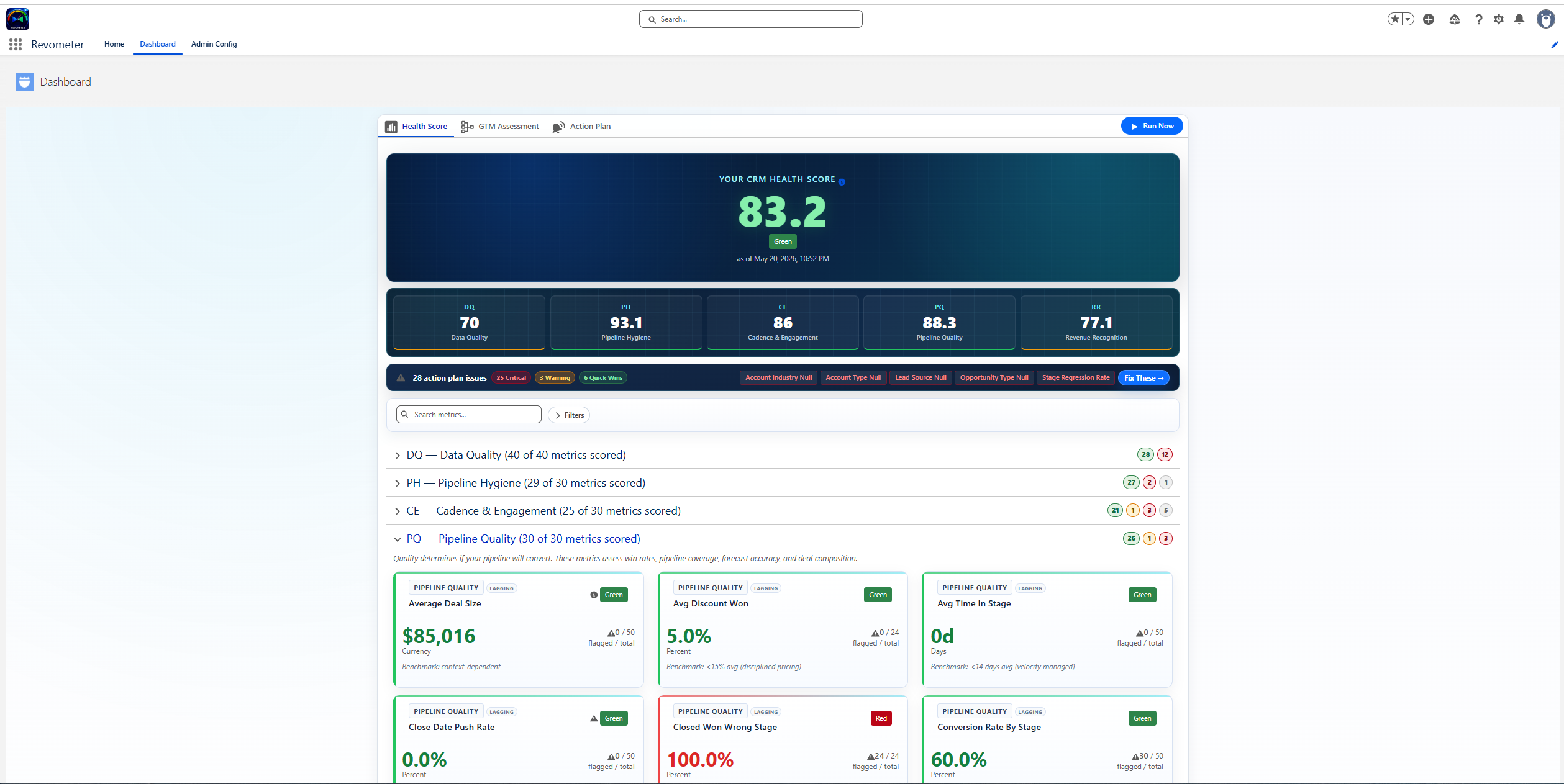
Tidy fields can still be strategically weak
Many cleanup projects focus on blanks, duplicates, and picklists. Those issues matter, but they do not prove the data can support attribution, forecasting, or AI-assisted decisions.
A populated source field can still be too vague for channel strategy.
A stage field can be current but disconnected from real buyer motion.
A renewal field can exist without enough context for expansion planning.
GTM context defines what clean means
Clean data should be judged against the job it needs to do. Acquire, Convert, and Expand each require different evidence, and each can fail for different reasons.
Acquire cleanup should protect source and account context.
Convert cleanup should improve pipeline and cadence confidence.
Expand cleanup should strengthen revenue and renewal evidence.
Revometer turns cleanup into a readiness plan
Instead of producing a generic list of dirty fields, Revometer scores evidence quality and prioritizes the fixes that make Salesforce more useful for strategy and AI.
Score data issues by operational impact.
Tie remediation to Bowtie zone confidence.
Use the action plan to sequence fixes before automation scales the problem.
FAQ
Why do CRM cleanup projects fail?+
They often focus on generic data hygiene instead of the specific GTM decisions the data needs to support.
What should come before AI adoption in Salesforce?+
Teams should validate whether Salesforce evidence is clean, contextualized, parameterized, and structured enough for AI to use safely.
Related reading